
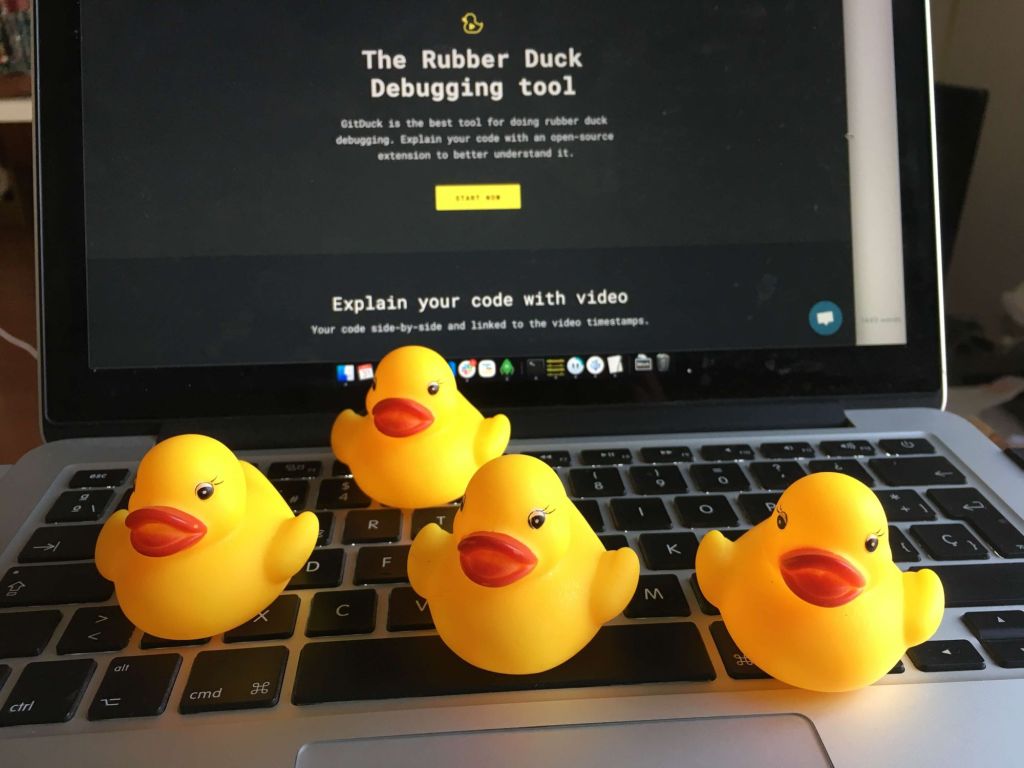
Rubber duck debugging is a method used by programmers to debug their code by explaining it, line by line, to an inanimate object, often a rubber duck. The term comes from a story in the book “The Pragmatic Programmer,” where a programmer carries around a rubber duck and debugs their code by forcing themselves to explain it, step by step, to the duck. Here’s how it works:
- Find a Rubber Duck: You need a rubber duck or any inanimate object that you can talk to.
- Explain the Code: Go through your code and explain what each part is supposed to do to the duck. Speak out loud and describe the logic and flow of your program.
- Identify Issues: As you articulate your thoughts and explain your code, you may notice mistakes or parts of the code that don’t work as expected. The act of explaining helps to clarify your understanding and can reveal issues you might not have noticed otherwise.
Why It Works
- Forces Clarity: Explaining your code requires you to think through it clearly and methodically, which can help you spot errors.
- Reveals Assumptions: Verbalizing your code can highlight incorrect assumptions or logic flaws.
- Simplifies Complex Problems: Breaking down complex code into simpler parts can make problems more manageable.
Example
Imagine you have a piece of code that calculates the factorial of a number:
def factorial(n):
    if n == 0:
        return 1
    else:
        return n * factorial(n-1)
To use rubber duck debugging, you would explain to the duck:
- “First, I define a function called
factorialthat takes an argumentn.” - “If
nis 0, I return 1 because the factorial of 0 is 1.” - “Otherwise, I return
nmultiplied by the result of callingfactorialwithn-1.”
As you explain this, you might realize that the code doesn’t handle negative numbers, or you might spot a potential problem with the recursive calls.
Benefits
- Improves Understanding: Explaining your code forces you to understand it better.
- Encourages Thoroughness: Going through the code line by line ensures that you consider every part of the program.
- Immediate Feedback: Although the duck doesn’t provide feedback, the process of explanation often leads to self-discovery of issues.
Rubber duck debugging is a simple yet effective technique that leverages the power of explanation to help programmers identify and fix bugs in their code.

