
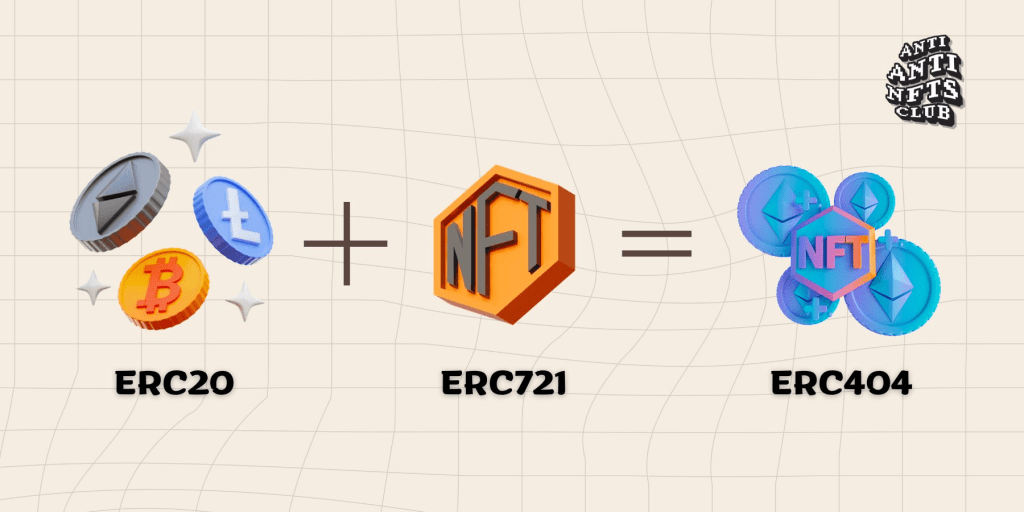
The ERC-404 token standard represents an experimental approach within the Ethereum ecosystem, aiming to amalgamate the traits of both fungible (ERC-20) and non-fungible tokens (ERC-721) into a hybridized form. This innovation facilitates the creation of assets on the blockchain that can exhibit both unique and divisible characteristics. Delving into the realm of ERC-404 tokens unveils insights into their functionality, potential applications, and notable projects within this domain.
Ethereum, renowned as the second-largest blockchain by market capitalization, has been instrumental in pushing the boundaries of blockchain technology and fostering the growth of cryptocurrencies. Its versatility, underpinned by smart contracts and programmable code, has empowered the development of a myriad of applications and decentralized financial (DeFi) solutions.
Token standards serve as foundational frameworks for token creation, each tailored to offer distinct functionalities and serve specific purposes. Among the recent innovations garnering attention is the ERC-404 token standard, heralding a convergence of fungibility and non-fungibility.
As of the present, ERC-404 tokens command a collective market capitalization surpassing $294 million, coupled with a robust trading volume exceeding $37 million. Despite its nascent stage and experimental nature, the ERC-404 token standard has swiftly gained traction, with Coinmarketcap listing 25 ERC-404 tokens as of March 2024.
The ERC-404 token standard, pioneered by the pseudonymous developers “ctrl” and “Acme,” represents an experimental yet groundbreaking approach within the Ethereum ecosystem. It seamlessly merges the characteristics of ERC-20 tokens, renowned for their fungibility akin to traditional currency, with those of ERC-721 tokens, celebrated for their uniqueness akin to non-fungible tokens (NFTs). This convergence gives rise to what is termed as “semi-fungible” tokens, enabling fractional ownership of indivisible NFTs.
This innovation unleashes a realm of possibilities, including fractional ownership of high-value digital assets such as artworks or real estate, enhanced liquidity for NFTs, and pioneering applications in decentralized finance (DeFi). Envision owning a fraction of an exclusive digital artwork in the guise of a fractional NFT—ERC-404 transforms this into reality, heralding a new era of fractional ownership, augmented NFT liquidity, and pioneering DeFi functionalities.
With its hybrid nature, ERC-404 aspires to offer adaptability, inherent liquidity, and programmable scarcity to digital assets traversing the Ethereum blockchain. Although unofficial and in its experimental phase, the ERC-404 standard facilitates fractional NFT ownership, ushering in a wave of experimentation and trading opportunities within the NFT landscape. By blending fungibility and non-fungibility within a singular token standard, ERC-404 promises innovative applications and utility in the realm of digital asset management and trading.
How ERC-404 Tokens Operate
ERC-404 tokens leverage smart contracts as their foundational framework to enable the subdivision and collective ownership of non-fungible tokens (NFTs). Each token represents a portion of an NFT, with the overall token supply reflecting the available shares. Users have the option to obtain individual tokens or amass enough to exchange them, thereby acquiring the complete NFT.
This mechanism not only enhances liquidity within the NFT market but also democratizes accessibility to high-value digital assets, fostering dynamic asset management and trading scenarios. Below is an in-depth exploration of how ERC-404 tokens function:
Integration of ERC-20 and ERC-721: ERC-404 tokens are engineered to operate as both fungible and non-fungible tokens. This is achieved by establishing a connection between each issued token (fungible) and an NFT (non-fungible), thus enabling a fusion of traits from both token categories.
Fractional Ownership of NFTs: A fundamental aspect of ERC-404 tokens is their capacity to facilitate fractional ownership of NFTs. This capability arises from linking a fungible token with an NFT, thereby enabling the division of the NFT into smaller, tradable segments. Such a mechanism serves to enhance liquidity and inclusivity within the NFT market.
Dynamic Minting and Burning: In instances where a fractional token, representing a portion of an NFT, is transacted, the associated NFT can undergo dynamic minting or burning. Should a fraction of a token be sold, the corresponding NFT is burned, whereas the addition of additional fractions to complete a token triggers the automatic minting of a new NFT. This seamless process facilitates the exchange and modification of NFT ownership and attributes based on transactions involving the underlying fungible tokens.
Potential Use Cases of ERC-404
Tokens By facilitating fractional ownership, ERC-404 tokens contribute to enhancing the liquidity of non-fungible tokens (NFTs), simplifying the trading of portions of high-value assets. This innovation significantly lowers entry barriers, fostering broader accessibility and participation in markets traditionally constrained by exclusivity.
Envision owning a fraction of renowned artwork, investing in premium real estate, participating in burgeoning gaming realms, or even having a stake in pioneering ventures—all made feasible through the adaptability and accessibility offered by ERC-404 tokens. The unique amalgamation of fungibility and non-fungibility presents novel opportunities for NFT projects and applications, encompassing but not limited to:
– Art & Collectibles: Fractional NFTs within these domains democratize access to costly artwork and rare collectibles.
– Real Estate: Tokenization of real estate assets facilitates fractional ownership and enhances investment accessibility
– Gaming & Metaverse: In-game assets or virtual land can be subdivided and exchanged with greater efficiency.
– Decentralized Funding: Fractionalized shares of startups or projects can be made available for community investment, fostering decentralized funding opportunities.

