
Oh wow, everything seems to be skyrocketing! Everyone else is making incredible wealth while I’m missing out…
I had a similar thought back in April and spent half a day trying to catch up. However, I’ve been through similar situations before, so today let’s take a look at the most popular memecoins and examine how much money they actually generated for buyers. Below are some observations and concerning statistics about their performance.
BRC20: All of them have resulted in losses.
These coins started later, have much less liquidity, and their total market share was around $450 million, but it has now dropped to $250 million. It’s important to note that 65% of that market share was always attributed to the original BRC20 ORDI, which has consistently been on a downward trend. Also, be cautious of the capitalization numbers as they can be manipulative on low trading volumes. If you want to learn more about Ordinals and how BRC20 surprised the Bitcoin ecosystem, you can scroll up. Additionally, the lack of wallets, trading tools, and trading analytics should also discourage further investment.
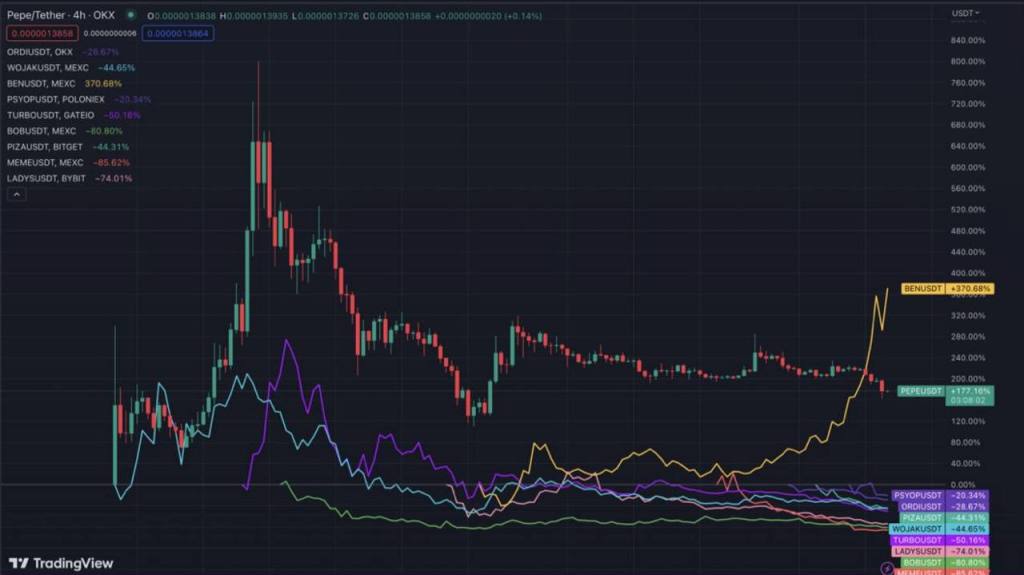
ERC20: A slightly better story in terms of profits, but still quite poor. Take a look at the chart below
The chart doesn’t include the exact launch pricing for all cases or all coins, as TradingView doesn’t immediately add them all. It merely visually represents the fact that unless you got in during the first week(s) before the end of April, you’re most likely experiencing losses. You can check Coingecko for more details. The peak interest in TradingView charts occurred around May 1, which is when most people actually entered the market.
The only coins that are still profitable are $PEPE and $BEN (created by an anonymous account), which was initially endorsed and later taken over by BitBoy Ben. Another coin, $PSYOP, was created by this anonymous Ben account. Although the token was launched just a couple of days ago, close to 95% of the supply is still held by the person who raised over $7 million in advance, and even the presalers don’t have access to their tokens. It’s fraudulent behavior all around. It seems they both went too far this time. Even Ran Neuner never engaged in such relentless scams.
But wait, DeFi coins also experienced a decline… Is it all a scam?
Well, there is a significant difference.
Here’s something to ponder over -Narrative Trading vs. Investing vs. Scamming-
Every asset has a price that can go up or down, but it’s important to consider the underlying narrative and fundamentals. Not just for the industry’s well-being, but for your own investment decisions. You can be as nihilistic as you want, but be true to yourself. That’s okay! However, if you buy into something without a clear narrative, no reason to hold it, and no promising future, there’s no guarantee that anyone else will buy it either.
Investing in literal scams means you:
a) need to be absolutely certain you’re among the first to invest
b) you rely on someone else to buy it from you later.
With legitimate investments, although you also sell to others eventually, you contribute to supporting builders and the creation of something tangible. An ecosystem gets developed, making it at least somewhat productive. This productive aspect, no matter how much it’s memed, plays a role in narratives. Even Verge memes heavily relied on privacy and Pornhub payment acceptance narratives in 2017-2018, while Dogecoin became popular as Elon Musk.
Please note that an image of the chart will be shared in a separate post below.

